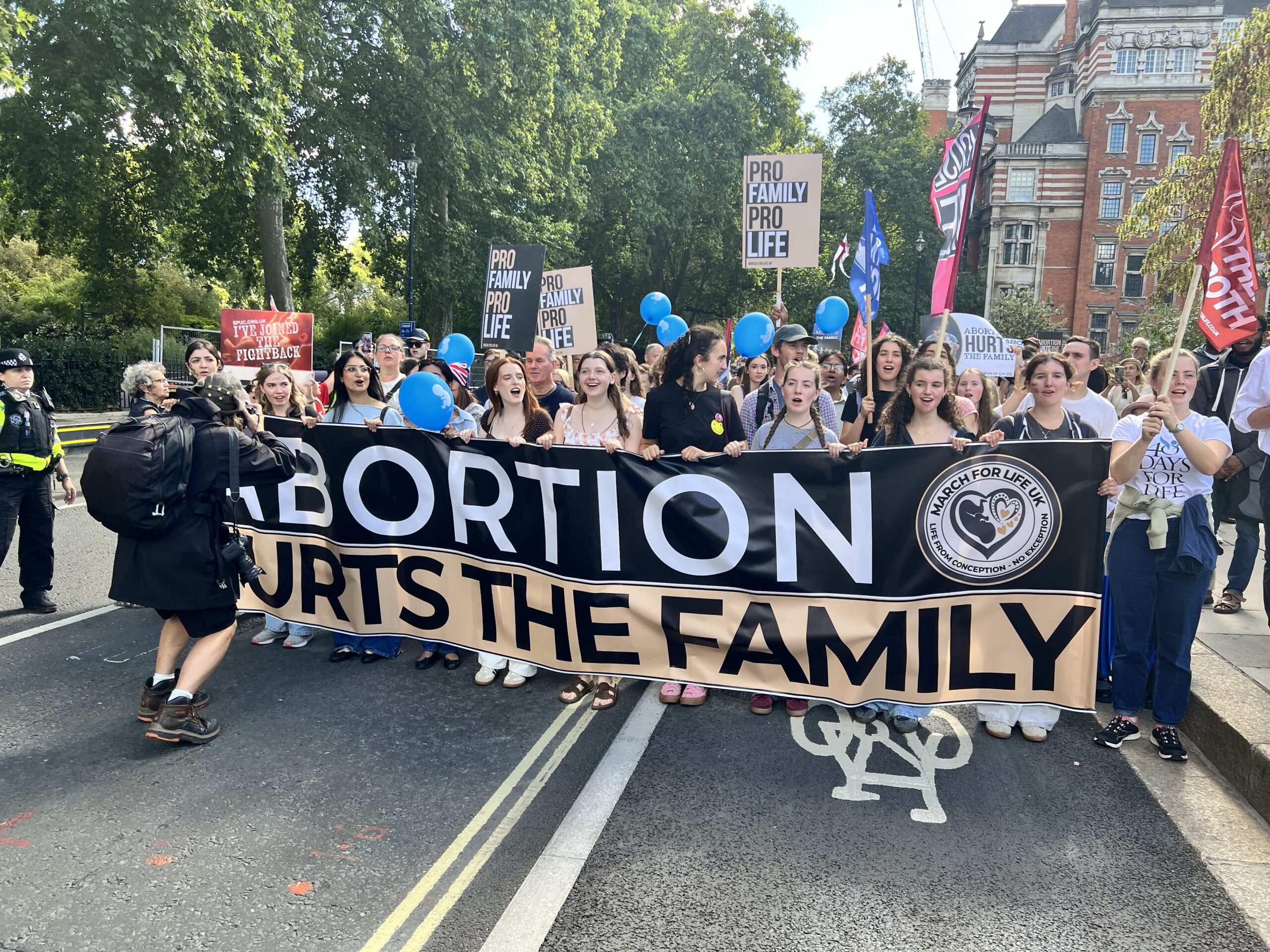
Yesterday, I attended the annual March for Life in Westminster, London, together with members of the EWTN Great Britain team, as we were invited to cover the event.
The March for Life is a peaceful public witness to the dignity and value of every human life. Yet, for many participants arriving in Westminster, “peaceful” was perhaps not the first word that came to mind.
The Holy Mass was celebrated at Westminster Cathedral, while talks and other events were taking place at the Emmanuel Centre, from where the march would later depart. One of our EWTN GB correspondents at the Holy Mass sent a voice message describing how distressing the atmosphere outside had become, while our cameraman at the Emmanuel Centre recorded protesters shouting through microphones.
One protester accused March for Life of conducting a “violent campaign against bodily autonomy.” Behind her was a banner declaring: Machistas, fascistas, no pasarán — “Sexists, fascists, they shall not pass.”
As I saw that footage and witnessed what was happening, I could not help but reflect on the striking contradiction.
Inside Westminster Cathedral, Catholics were attending Holy Mass. At the Emmanuel Centre, families, speakers, and supporters were gathering peacefully, preparing to take part in a public witness for the dignity of human life. Yet outside, some protesters were shouting through microphones and creating what many participants experienced as a hostile and intimidating atmosphere — while at the same time accusing the pro-life movement of violence.
I found this deeply troubling.
We are constantly told that tolerance is one of the highest virtues of modern society. Yet, watching the events unfold, I was left wondering whether tolerance is sometimes expected to work only in one direction: that we must accept the beliefs of others, while our own beliefs are expected to remain unspoken.
Catholics have the right to worship. We have the right to pray. We have the right to gather peacefully and to speak publicly in defence of human life. We do not demand these freedoms only for ourselves; we should recognise them for others as well.
What struck me most was the language being used. A peaceful objection to abortion was described as “violence”, while the reality of what abortion does to an unborn child was largely absent from the discussion.
They speak of “bodily autonomy”, yet there is another body that cannot speak for itself — the body of the child in the womb.
It reminded me that our struggle for the dignity of human life is not merely a political or cultural debate. As Christians, we are also engaged in a spiritual struggle, and our response must therefore be rooted in prayer, charity, courage, and trust in God.
For me, this is precisely why a public witness such as the March for Life remains necessary. Whatever terminology we use, abortion involves the deliberate ending of the life of a developing human being. To stand peacefully in opposition to this is not an act of hatred or violence. It is, for me, an act of love and a recognition of the dignity of every human person, including the smallest and most vulnerable among us.
I also believe that we must never allow hostility from others to determine how we respond. Those who disagree with us are free to protest, and we should respect their right to express their views. But disagreement should not become intimidation, nor should the freedom to protest become an excuse to prevent others from worshipping, praying, or peacefully expressing their convictions.
After Mass, we made our way towards the Emmanuel Centre before setting out together on the march. Despite the shouting and hostility around us, I was struck by the determination of the people who continued to walk, pray, and witness peacefully.
There was one particular moment that stayed with me. As the 15 Catholic Bishops gave the final blessing, the protesters outside suddenly began shouting continuously, without any apparent reason. Standing there and hearing the shouting while the Bishops imparted their blessing, I could not help but see the moment through the eyes of faith. To me, it felt like a manifestation of spiritual warfare.
As I walked through the streets of Westminster, I was reminded once again why I was there.
We march not because we hate women, but because we refuse to abandon either mother or child. We march not because we seek confrontation, but because we believe that every human life possesses an inherent dignity and deserves protection.
They may shout. They may disagree with us. But we will continue to pray, to speak, and to witness peacefully for life.
And for me, that is what the March for Life is ultimately about: a peaceful witness to the dignity of every human life, especially those who have no voice of their own.
Discover more from Chavez Cyrillus Mariae Poon
Subscribe to get the latest posts sent to your email.