The Annunciation (Annuntiatio) is the First Joyful Mystery of the Holy Rosary, commemorating the visit of the Archangel Gabriel to the Blessed Virgin Mary and his announcement that she had been chosen to become the Mother of the Saviour, Jesus Christ.
The liturgical celebration of the Annunciation is of considerable antiquity in the Christian tradition. In the Latin Church, the feast is first attested in the Sacramentarium Gelasianum, commonly associated with Pope Gelasius I and dating from the late fifth century. Its origins, however, are generally associated with the period following the Council of Ephesus in 431 AD, the Third Ecumenical Council, which solemnly affirmed the Blessed Virgin Mary as Theotokos, the Mother of God.
The development of the feast therefore belongs to a period in which the Church’s liturgical life increasingly expressed, through the celebration of the mysteries of Christ, the dignity and unique role of the Blessed Virgin Mary in the economy of salvation.
The Feast of the Annunciation is celebrated on 25th March, exactly nine months before the solemnity of the Nativity of the Lord. The date therefore reflects the traditional understanding of the Annunciation as the moment of the Incarnation, when the Archangel Gabriel announced to the Blessed Virgin Mary that she had been chosen to become the Mother of the Saviour.
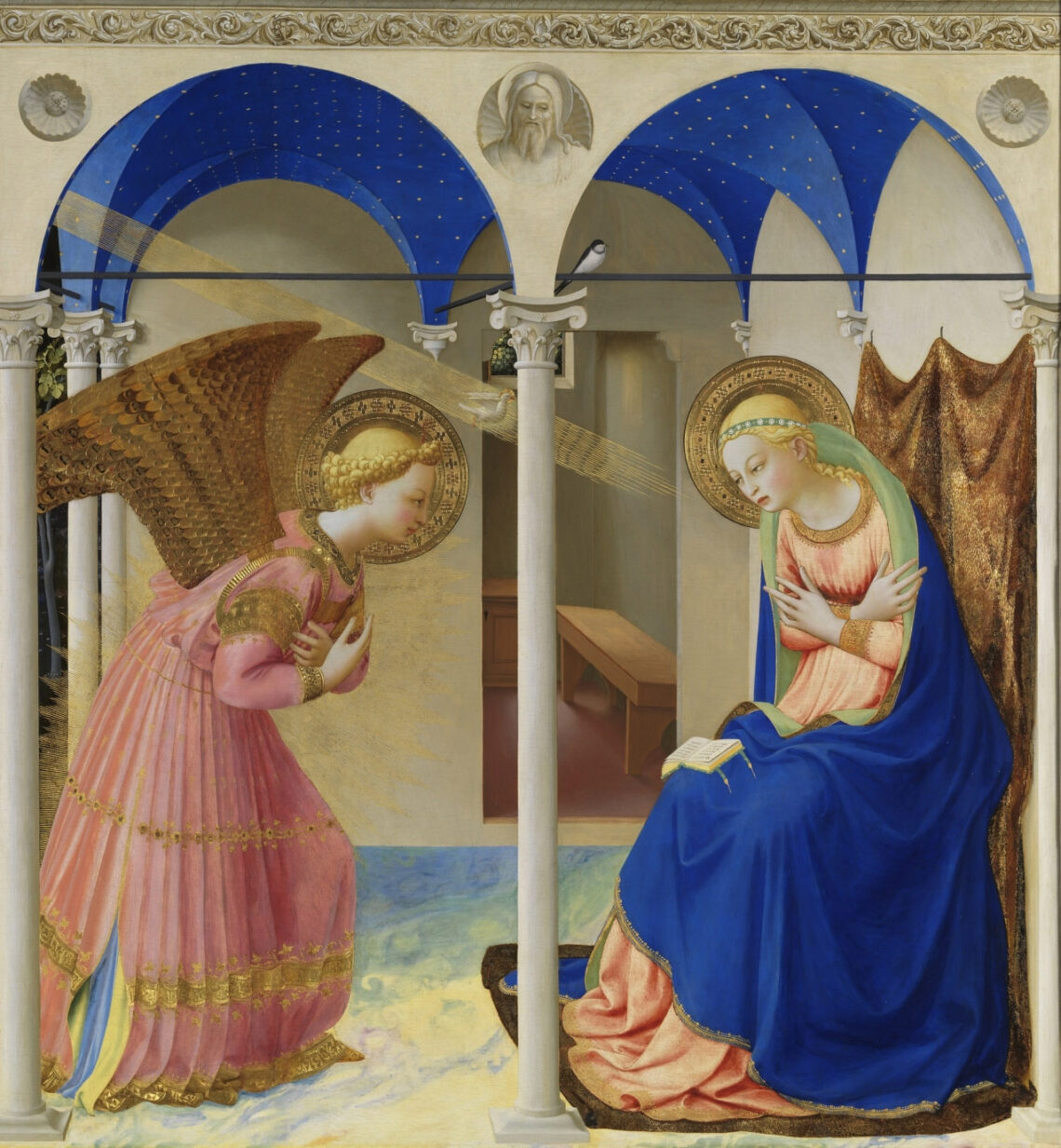
The painting above, by Fra Angelico, is one of the countless examples of sacred artwork inspired by this important feast of the liturgical year. The mystery of the Annunciation has long been a particularly rich subject within Christian art, expressing the humility of the Blessed Virgin, the angelic proclamation, and the beginning of the fulfilment of God’s plan of salvation.
The Gospel according to St. Luke gives the following account of the Annunciation:
In the sixth month the angel Gabriel was sent by God to a town in Galilee called Nazareth, to a virgin engaged to a man whose name was Joseph, of the house of David. The virgin’s name was Mary. And he came to her and said, “Greetings, favoured one! The Lord is with you.” But she was much perplexed by his words and pondered what sort of greeting this might be.
The angel said to her, “Do not be afraid, Mary, for you have found favor with God. And now, you will conceive in your womb and bear a son, and you will name him Jesus. He will be great, and will be called the Son of the Most High, and the Lord God will give to him the throne of his ancestor David. He will reign over the house of Jacob forever, and of his kingdom there will be no end.”
Mary said to the angel, “How can this be, since I am a virgin?” The angel said to her, “The Holy Spirit will come upon you, and the power of the Most High will overshadow you; therefore the child to be born will be holy; he will be called Son of God. And now, your relative Elizabeth in her old age has also conceived a son; and this is the sixth month for her who was said to be barren. For nothing will be impossible with God.”
Then Mary said, “Here am I, the servant of the Lord; let it be with me according to your word.” Then the angel departed from her. — (Lk 1:28–38)
In traditional Western art, the angel usually appears on the left and Mary on the right, suggesting that the angel delivers the message of God to Mary. The halos around their heads symbolise their holiness. In the painting, the angel genuflects to Mary to signify her being “full of grace”; on the other hand, Mary slightly bows with her arms crossed over her breast, showing her respect for the Angel of God and that she is troubled by the Angel’s greeting.
She sits on a throne-like golden chair, which signifies her dignity as the Mother of God, who is to conceive and bear our Lord Jesus Christ. Very often in paintings of the Annunciation, Mary is depicted reading the Scripture quoted from Isaiah 7:15:
Therefore the Lord himself shall give you a sign. Behold a virgin shall conceive, and bear a son, and his name shall be called Emmanuel.
The fact that a virgin gives birth to a child is, apparently, a supernatural event. Light shines from the top-left-hand corner directly onto Mary, together with a dove in the middle of the painting, reiterating that the Holy Spirit is overshadowing Mary and emphasising the supernatural nature of the event. On top of the pillar in the middle is an icon of God the Father, showing His presence in the mystery.
On the left side of the painting, there are a man and a woman in green pastures, together with an angel in the sky. The motif is the expulsion of Adam and Eve from Eden after committing original sin. The expulsion is, in fact, very closely related to the Annunciation, as the Annunciation is the beginning of Christ’s salvation, while the Fall of our Original Parents is the reason for God’s salvation.
When we look at ourselves, are we joyful to receive God’s grace and ready to
respond to our fiat?
Discover more from Chavez Cyrillus Mariae Poon
Subscribe to get the latest posts sent to your email.