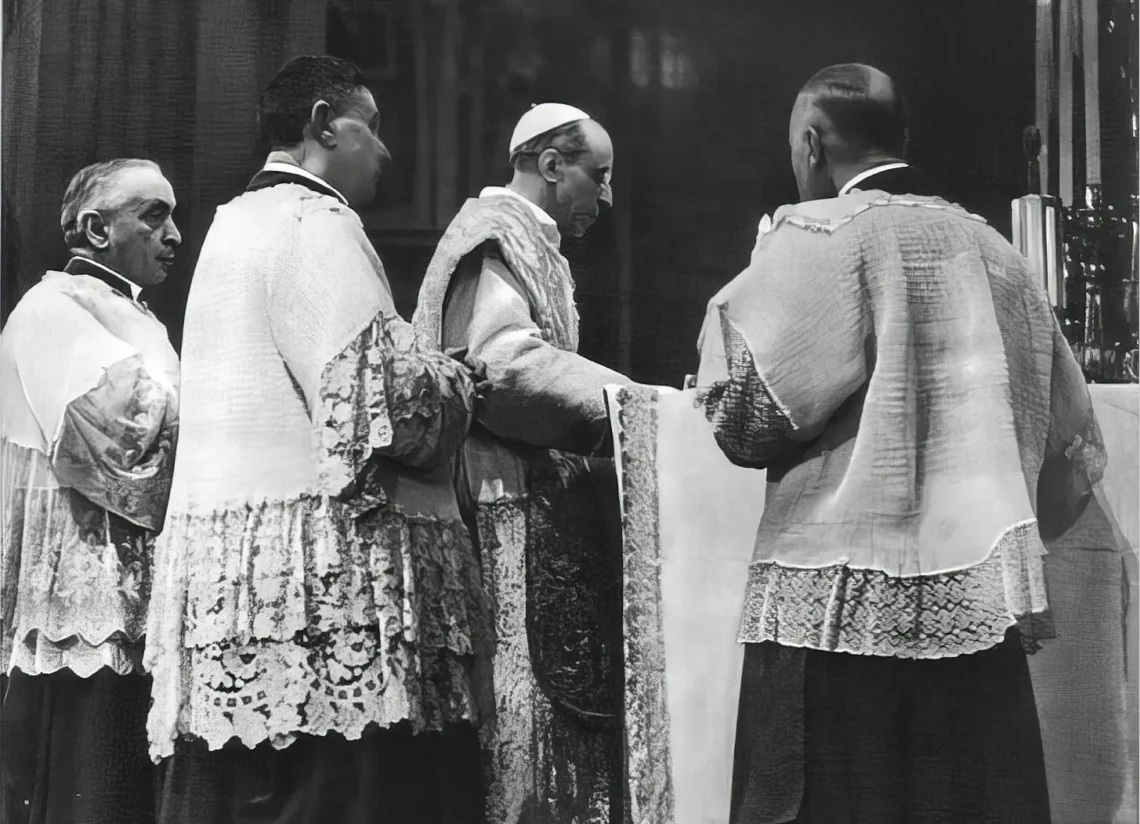
One of my vestment collection is the antique Cotta Griccia alla Romana, which I think many Roman liturgical lore will remember well as a distinctive design style of a Roman cotta.
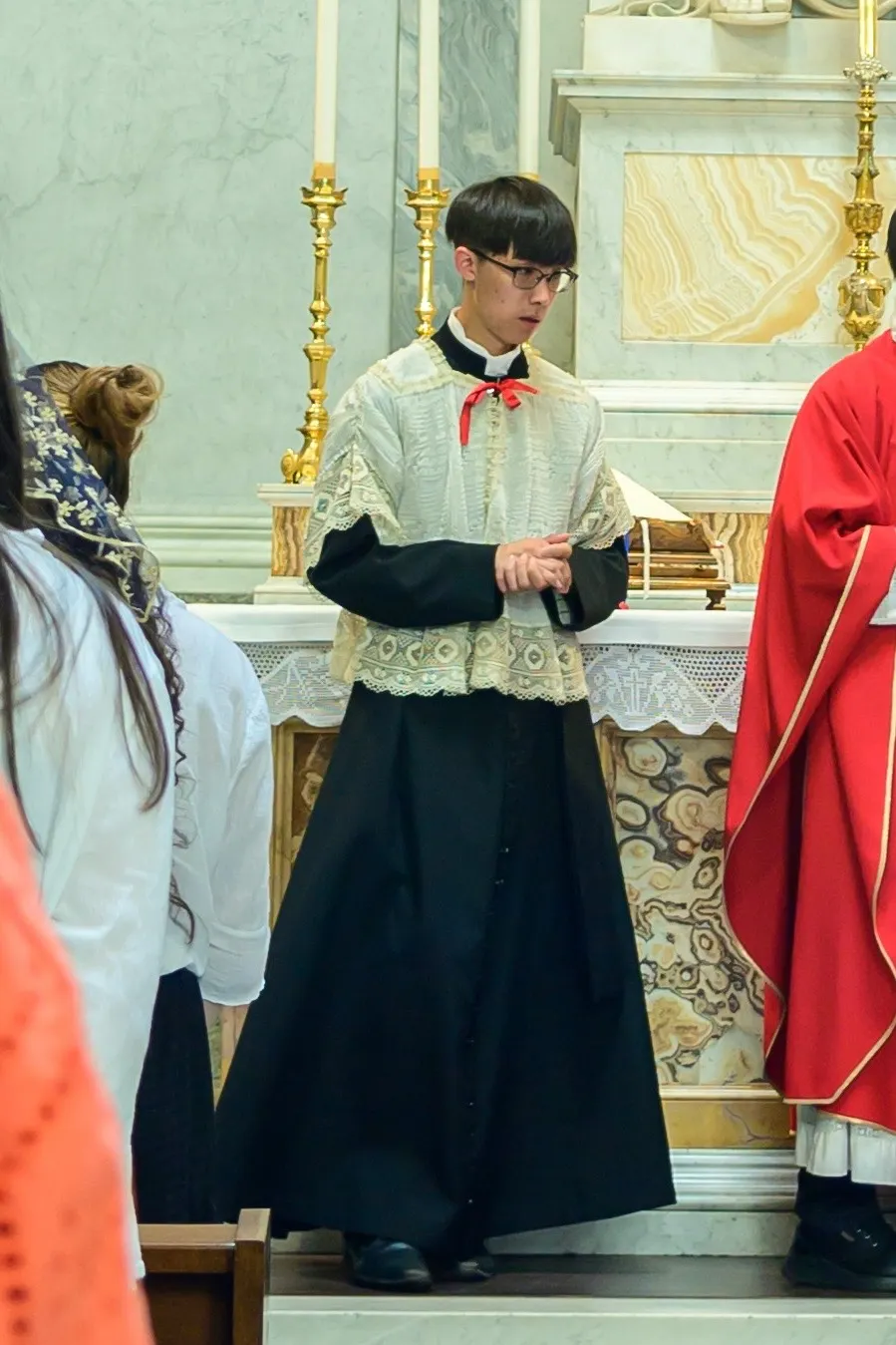
The Cotta Griccia, particularly in the Roman style, is recognisable by its characteristic pleated construction. The fabric is arranged into numerous small, regular pleats, producing a fuller and more structured garment than many of the simplified cottas commonly encountered today. These pleats are not merely decorative. They form an important part of the garment’s construction and give the cotta its distinctive Roman appearance.
The term griccia itself is associated with this pleated character. In historic examples, the pleating can be remarkably fine and carefully executed, requiring considerable skill in the preparation and maintenance of the garment. When worn over a cassock, the effect is unmistakable: the white pleated fabric falls generously from the shoulders, creating a sharp visual contrast with the dark clerical garment beneath.
What makes the Cotta Griccia alla Romana particularly interesting to an antiquarian is its construction.
Rather than relying principally upon elaborate embroidery or rich coloured materials, its beauty is found in the manipulation of white linen or cotton itself. The repeated pleats create rhythm across the garment, while the fullness of the fabric gives it a dignified silhouette.
This is a good example of an important principle in traditional ecclesiastical craftsmanship: ornament need not always mean additional decoration. The structure of the garment itself can become ornamental.
The fine pleating catches light differently across the surface of the fabric. As the wearer moves, the folds open and close slightly, giving an otherwise simple white garment a remarkably animated appearance. When viewed alongside the black cassock, the visual effect is both restrained and ceremonial.
Historic Roman examples also remind us that garments intended for the sanctuary were often constructed with considerably more care than their apparent simplicity might suggest. The cotta might be handled, folded, washed and ironed repeatedly, and therefore required sound construction if it was to survive years of service.
This is one reason why I particularly value having an antique Cotta Griccia in my own vestment collection. Far from being merely a historical artefact, it continues to serve its original purpose: I still wear it today during liturgical services. In this way, the garment remains not simply an object preserved from the past, but a living part of the Church’s continuing liturgical tradition.
An old liturgical garment is not simply an old piece of clothing. It can function as a small piece of material evidence.
Its fabric tells us something about historical textile production. Its cut can reveal contemporary conventions of dress. Its stitching and pleating demonstrate the craftsmanship available to the sacristan or vestment maker. Signs of wear can even provide clues about how frequently and in what circumstances it was used.
Unfortunately, much historic liturgical vesture has disappeared. Some garments were discarded when they became worn; others were altered to suit later fashions, while still others were simply replaced by inexpensive modern equivalents.
Consequently, surviving examples deserve a certain degree of care.
The antique Cotta Griccia in my collection is therefore interesting to me not merely because of its appearance, but because it represents a surviving fragment of an older ceremonial culture.
Perhaps the most interesting thing about the Cotta Griccia is that it is, in one sense, an ordinary garment.
It does not possess the visual splendour of a Gothic chasuble embroidered with gold thread. It does not have the monumental character of a processional cope. It is simply a white garment worn over a cassock.
Yet precisely because it was ordinary, it was part of the everyday life of the Church.
Generations of clergy and servers wore garments of this kind for Mass, Benediction, processions, Vespers, and other sacred functions. It belonged to the daily rhythm of Catholic worship. Its historical importance therefore lies partly in its ordinariness.
There is something deeply fascinating about preserving an object that may once have been completely unremarkable to the people who used it.
Today, the same garment can appear almost exotic because the liturgical environment in which it developed has changed so considerably.
The study of historic vesture should not be reduced merely to nostalgia. Antique vestments provide an opportunity to understand how the Catholic Church expressed her theology, hierarchy and ceremonial life through material culture.
The Cotta Griccia alla Romana demonstrates how even a relatively simple garment could embody the principles of dignity, order, proportion and craftsmanship.
For me, preserving one in my collection is therefore a small way of keeping alive an awareness of this heritage. It allows me to examine not only the garment itself, but also the hands and traditions behind it—the vestment makers who constructed it, the sacristans who maintained it, and the generations of Catholics who encountered it as part of the sacred ceremonies of the Roman Church.
An antique cotta may never have been intended to become a museum object. It was made to be worn, washed, ironed, folded and worn again.
And perhaps that is precisely what makes it valuable.
The Cotta Griccia alla Romana is a modest object, but it is a witness to a much larger history: the history of Roman ceremonial life, ecclesiastical craftsmanship and the material culture of Catholic worship.
In its pleats and linen, one can still glimpse something of the Roman sacristy of another age.
Discover more from Chavez Cyrillus Mariae Poon
Subscribe to get the latest posts sent to your email.