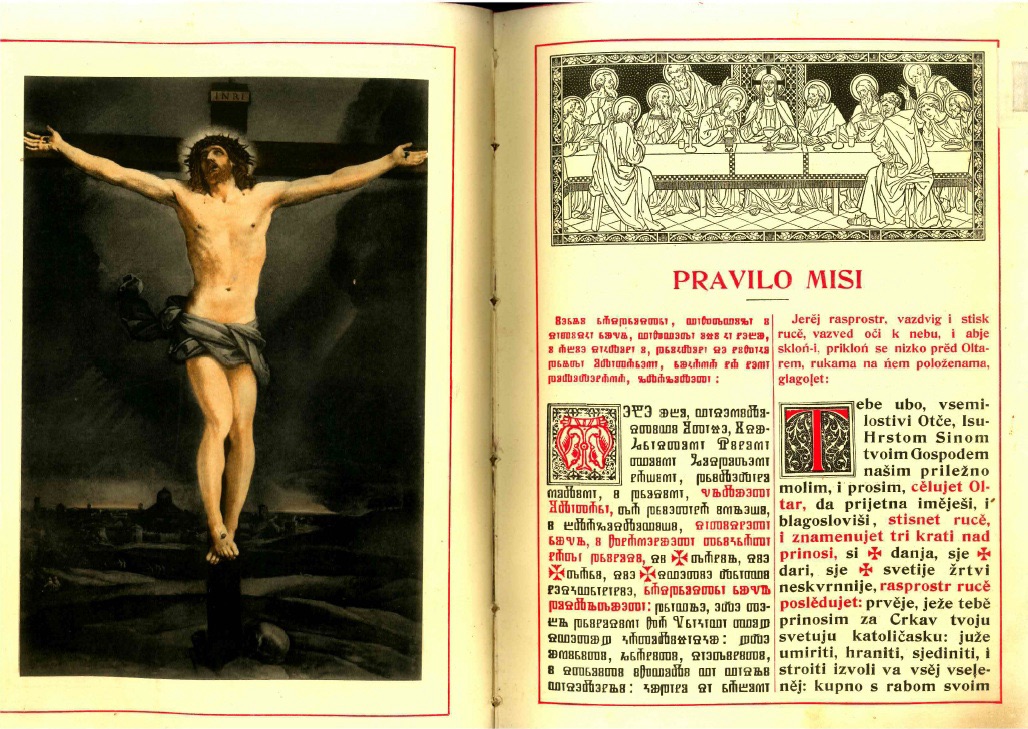
For many Roman Catholics, the language of the traditional Western Latin Roman Rite is inseparably associated with Latin. Yet throughout the Church’s history, there have been remarkable exceptions that beautifully demonstrate the Catholicity — the universality — of the Holy Mother Church. Among the most fascinating of these is the Glagolitic Holy Mass, a unique expression of the Roman Rite celebrated in Old Church Slavonic.
The Glagolitic tradition traces its origins to the ninth century, when Sts. Cyril and Methodius, the “Apostles to the Slavs”, evangelised the Slavic peoples. To proclaim the Gospel in a language the people could understand, they translated the Scriptures and liturgical texts into Old Church Slavonic and devised the Glagolitic alphabet, the oldest known Slavic script. Their missionary work laid the foundations for the Christianisation of much of Eastern Europe.
Although the Roman Church has traditionally celebrated the Sacred Liturgy in Latin, the Holy See granted special permission to certain regions along the Adriatic coast — particularly in present-day Croatia — to celebrate the Roman Rite in Old Church Slavonic using the Glagolitic script. This privilege, preserved for centuries, made the Glagolitic Mass one of the very few legitimate vernacular traditions within the Latin Church before the liturgical reforms of the twentieth century.
The Glagolitic Mass followed the Roman Rite, sharing the same structure, prayers, and theology as the Latin Mass. The only difference was the sacred language and script in which the texts were written. This remarkable tradition demonstrates that the Church’s unity has never depended solely upon one spoken language, but upon a shared faith, common worship, and communion with the Successor of St. Peter.
The visual beauty of Glagolitic manuscripts is equally captivating. Their distinctive angular characters, carefully penned by generations of scribes, transformed liturgical books into works of sacred art. These manuscripts remain treasured witnesses to the rich cultural and spiritual heritage of the Croatian Church.
Today, the Glagolitic liturgical tradition is celebrated only on rare occasions, often as part of cultural, historical, or academic commemorations. Nevertheless, it continues to inspire those who discover it, reminding us that the Church has always embraced legitimate diversity within the unity of the Roman Rite.
For Catholics who cherish the Church’s liturgical heritage, the Glagolitic Mass offers a glimpse into a forgotten yet enduring chapter of our history. It reminds us that the Gospel has been proclaimed in many tongues while preserving one faith. It also highlights the missionary zeal of Sts. Cyril and Methodius, whose vision enabled countless peoples to encounter Christ through the beauty of the sacred liturgy.
In an age when many are rediscovering the treasures of Catholic tradition, the Glagolitic Holy Mass stands as a profound testimony to the universality of the Church — a tradition that is at once deeply Roman, authentically Slavic, and unmistakably Catholic.

