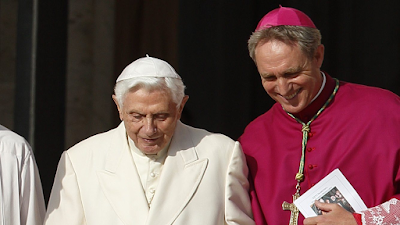
Former Prefect of the Papal Household, Archbishop Georg Gänswein, has expressed a hopeful outlook regarding the restrictions placed on the pre-reform Roman Rite by Pope Francis through the July 2021 Motu Proprio Traditionis Custodes. In a recent dialogue with Italian media, Archbishop Gänswein stated he had “read with interest” an appeal advocating for the abolition of these restrictions and conveyed his desire for a “decision in this direction” to be made in the future.
Currently serving as the Apostolic Nuncio to the Baltic States, Archbishop Gänswein shared poignant memories of his time alongside Pope Benedict XVI, particularly recalling the “pain in his heart” that the late Pope felt upon reading the decree issued by his successor. Emphasizing the gravity of the situation, the Archbishop remarked, “I believe this is the opportune moment” to consider lifting those restrictions. He further suggested that it is essential to move past the setback that represented the introduction of Traditionis Custodes for the sake of unity within the Church.
The timing of this interview is significant, coinciding with the 19th anniversary of Pope Benedict XVI’s issuance of the motu proprio Summorum Pontificum in 2007. This earlier document was pivotal in broadening access to the celebration of the pre-1970 Roman Rite, aiming to “grant full rights to a rite that had never been abolished.” Archbishop Gänswein articulated that this initiative sought to restore the pre-reform rite’s rightful place in the Church’s liturgical life, thereby fostering reconciliation and healing decades of liturgical division among different factions within the Church.
Despite the criticism that often surrounded Pope Benedict XVI, Archbishop Gänswein highlighted that he remained unwavering whenever he felt particularly convinced that a certain course of action was necessary for the good of the Church. This conviction was instrumental in the promulgation of Summorum Pontificum, a document that has significantly influenced the dialogue surrounding the traditional liturgy in recent years.
Delving deeper into the origins of the motu proprio, Archbishop Gänswein recalled Pope Benedict’s personal involvement in the fraught negotiations with Archbishop Marcel Lefebvre, the founder of the Society of St. Pius X, back in 1988. As Cardinal Joseph Ratzinger, Pope Benedict had signed both a doctrinal declaration and a proposed canonical agreement with Archbishop Lefebvre on May 8, 1988, which contained provisions for the future consecration of a bishop for the Society. However, the subsequent refusal of Archbishop Lefebvre to adhere to the agreed terms marked a pivotal point in the relationship between the Society and the Holy See.
On June 30, 1988, Lefebvre proceeded with the episcopal consecrations despite lacking pontifical mandate, effectively disregarding the agreement reached with the Vatican. Archbishop Gänswein noted, “For him, having experienced firsthand the agreement that Lefebvre reneged on in 1988, the schism was a personal source of suffering.” He reflected on how Pope Benedict believed that this schism would not merely be a temporary setback, but rather a profound wound to the Church’s unity that would have lasting ramifications.
Through these reflections, Archbishop Gänswein sheds light on the complexities surrounding the liturgical developments within the Church, emphasizing a need for dialogue, respect, and ultimately, reconciliation in the pursuit of unity among the faithful. This perspective might pave the way for a renewed understanding and appreciation of the traditional liturgy, fostering an environment where all rites may coexist harmoniously within the Church’s life.