Why Don't the Five Virgins Share Their Oil?
Faith cannot be borrowed. The Parable of the Ten Virgins reminds us that every Christian must personally prepare his soul for the coming of the Bridegroom through faith, charity, good works, and perseverance.
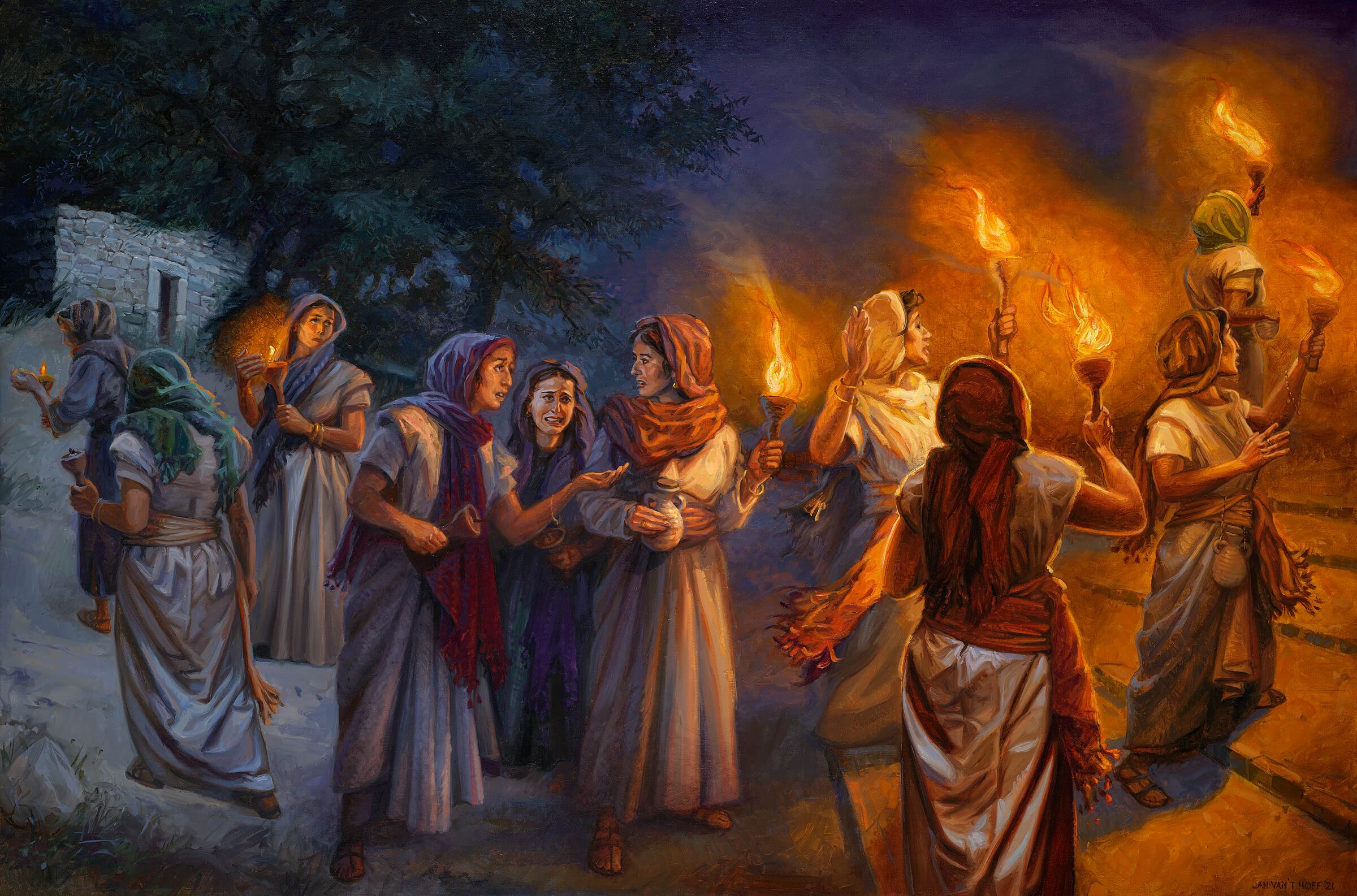
In the Gospel according to St. Matthew (25:1–13), Our Lord Jesus Christ presents the Parable of the Ten Virgins. Ten virgins took their lamps and went out to meet the bridegroom. Five were wise, while the other five were foolish. The wise virgins brought additional oil in their vessels, whereas the foolish ones took their lamps without making adequate provision.
When the bridegroom was delayed, they all became drowsy and fell asleep. At midnight, however, a cry was heard: "Behold, the bridegroom cometh; go ye forth to meet him." All ten virgins arose and trimmed their lamps. But the lamps of the foolish virgins were going out, and they had no additional oil.
They therefore approached the wise virgins and said: "Give us of your oil; for our lamps are gone out." The wise virgins refused, saying that there might not be enough for both themselves and the others. The foolish virgins consequently went away to purchase more oil. While they were gone, the bridegroom arrived, and those who were ready entered with him into the marriage feast. The door was then shut.
The parable concludes with a solemn warning from Our Lord:
"Watch ye therefore, because you know not the day nor the hour." (Matthew 25:13)
At first glance, the response of the five wise virgins might appear rather uncharitable. Why would they refuse to share their oil with the other five? Should not Christians be generous towards one another, especially when someone is in need?
However, the Church Fathers offer a deeper interpretation. Their reflections reveal that the oil is not merely a physical substance but a spiritual reality that concerns the life of every Christian.
The Oil: The Fruit of Good Works
In his Catena Aurea, St. Thomas Aquinas brings together the commentaries of several Church Fathers on this Gospel passage. Their interpretations help us understand the spiritual significance of the oil carried by the wise virgins.
St. Hilary of Poitiers explains:
"The 'oil' is the fruit of good works, the 'vessels' are the human bodies in whose inward parts the treasure of a good conscience is to be laid up."
Similarly, St. Jerome distinguishes between those who possess faith accompanied by good works and those who profess faith but neglect the practice of virtue:
"The virgins that have oil are they who, besides their faith, have the ornament of good works—they that have not oil, are they that seem to confess with like faith, but neglect the works of virtue."
These interpretations invite us to consider an essential aspect of Christian life: faith must bear fruit.
It is not enough merely to profess belief in God while neglecting the commandments of Our Lord. Christian faith must be expressed through charity, mercy, obedience, and the practice of virtue. A Christian cannot be satisfied with the outward appearance of religious devotion while allowing his interior life to become spiritually empty.
St. John Chrysostom offers another interpretation of the oil:
"The 'oil' denotes charity, alms, and every aid rendered to the needy."
Here, the oil is associated particularly with charity and the practical expression of love towards our neighbours. Our relationship with God cannot be separated from the way we treat other people. The corporal and spiritual works of mercy are not merely optional decorations of Christian life; they are expressions of the charity that should animate every Christian soul.
The five wise virgins, therefore, represent those who have prepared themselves through a life of faith, charity, and good works. Their lamps are not sustained by appearances alone but by the spiritual substance accumulated through their faithful lives.
Why Cannot the Oil Be Shared?
This brings us to the central question of the parable: why did the wise virgins refuse to share their oil?
The answer is not that Christians should refuse to help one another. On the contrary, charity requires us to assist our neighbours, especially those who are spiritually or materially in need.
Rather, the refusal illustrates a fundamental truth about our personal responsibility before God: another person's good works cannot replace our own, and another person's holiness cannot substitute for our personal conversion.
St. John Chrysostom explains the response of the wise virgins:
"The wise answered, saying, 'Not so, lest there be not enough for us and you;' hence we learn that none of us shall be able in that day to stand forth as patron of those who are betrayed by their own works, not because he will not, but because he cannot."
This is a particularly striking observation. At the moment of judgement, no one can stand in place of another and present another person's good works as though they were his own.
Our parents may teach us the faith, priests may administer the Sacraments, religious communities may provide spiritual formation, and friends may encourage us through prayer and example. These are all invaluable gifts of Christian fellowship. Nevertheless, each person must personally respond to God's grace.
We cannot simply borrow the holiness of a saint, rely exclusively upon the prayers of our family, or assume that belonging to a religious community automatically makes us spiritually prepared.
The grace of God is freely offered to us, but we must cooperate with that grace. Each Christian is responsible for cultivating a living relationship with God.
Faith cannot be borrowed.
The Final Account of Our Lives
The Fathers also draw attention to what happens when the bridegroom finally arrives.
St. Gregory the Great explains the virgins' trimming of their lamps in these words:
"Both elect and reprobate are roused from the sleep of death; they 'trimmed their lamps,' that is, they reckon up to themselves their works for which they look to receive eternal blessedness."
St. Augustine similarly observes:
"They 'trimmed their lamps,' that is, prepared to give an account of their deeds."
The imagery is solemn. The arrival of the bridegroom signifies the coming of Christ, and the awakening of the virgins reminds us of the final judgement.
Every human life will eventually come before God. Our earthly existence is not without purpose, nor are our actions without consequence. The way we live, the choices we make, the charity we practise, and the opportunities for holiness that we embrace all form part of our response to God's grace.
The parable therefore challenges us to examine our conscience.
Are our lamps burning brightly, sustained by faith and charity? Or have we become complacent, relying upon the outward appearance of religious observance while neglecting the interior life?
It is possible to appear religious before others while remaining spiritually unprepared. The foolish virgins also possessed lamps. They also went out to meet the bridegroom. They were not entirely different from the wise virgins in outward appearance. Their deficiency was that they had failed to make adequate provision.
This distinction is especially important. Christian life is not simply about appearing faithful; it is about becoming faithful.
The Danger of Spiritual Complacency
Another important detail in the parable is the delay of the bridegroom.
All ten virgins became drowsy and fell asleep. The distinction between the wise and the foolish was not that one group remained awake while the other slept. Rather, it was that the wise had prepared themselves beforehand.
The delay represents the uncertainty of the Lord's coming. We do not know when Christ will return, nor do we know the hour of our own death. We therefore cannot postpone our conversion indefinitely or assume that there will always be another opportunity to put our spiritual lives in order.
How often do we say that we will pray more tomorrow, go to confession another day, forgive someone later, or begin practising charity when circumstances become more convenient?
The foolish virgins remind us of the danger of such spiritual procrastination.
Preparation for the Kingdom of Heaven cannot be reduced to a last-minute decision. It requires a life of perseverance, prayer, repentance, and fidelity to God.
The words of Our Lord are therefore not merely a warning about the future. They are an invitation to live faithfully in the present.
Keep Your Lamps Burning
The Parable of the Ten Virgins is ultimately a lesson about Christian vigilance and personal responsibility.
The oil represents the spiritual fruit of a life lived in accordance with God's grace: faith expressed through good works, charity towards our neighbours, and perseverance in virtue. It is something that must be cultivated throughout our earthly pilgrimage.
This does not mean that salvation is earned independently of God's grace. Rather, our good works are the fruit of a living faith and our cooperation with the grace that God freely gives us.
We should certainly pray for one another, encourage one another, practise the works of mercy, and help those who are struggling in their faith. Yet we must never mistake the assistance of others for a substitute for our own relationship with God.
When the Bridegroom comes, we cannot rely upon another person's spiritual preparation to make up for our own negligence.
The five wise virgins teach us that the time to prepare is now. We must cultivate our faith, practise charity, seek forgiveness, and persevere in holiness while the opportunity remains.
For the door will eventually be shut, and the Bridegroom will come at an hour we do not expect.
May we therefore take seriously the words of Our Lord:
"Watch ye therefore, because you know not the day nor the hour."